


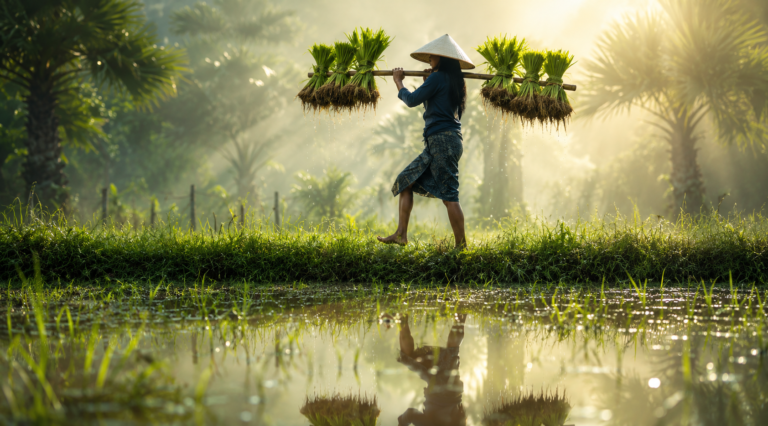
Water systems are under stress across the region, and that puts sustainable farming, better nutrition, and everyone’s health at risk.
Asia and the Pacific’s food story has always been a water story.
From the Indus to the Mekong, the Yellow River to the Ganges, rivers have shaped civilizations, nourished crops, and powered trade. That relationship is under strain. The region is home to over half the world’s people but holds far less than its share of freshwater. Demand is rising, even as rivers, aquifers, and ecosystems face mounting stress.
Food security begins long before food reaches the table. The region feeds more than 4 billion people using just 28% of global freshwater and 30% of arable land. Yet, more than three-quarters of the region’s land experiences water stress. Rice—the predominant staple—uses about 40% of irrigation water, and almost half of cropland is degraded, undermining productivity and ecological resilience.
In six decades, Asia and the Pacific experienced three waves of transformation. The Green Revolution doubled cereal yields in countries such as India and Indonesia. Rural industrialization connected farms to processing and markets. Globalization turned Thailand and Viet Nam into major agricultural exporters.
These shifts slashed hunger—but generated hidden costs. South Asia now hosts some of the world’s most groundwater-stressed basins. Fertilizer use in parts of East and Southeast Asia more than quadrupled since the 1970s, polluting rivers and creating coastal dead zones. Diets have narrowed toward calorie sufficiency rather than nutritional diversity.
A changing climate compounds these pressures. Glaciers in the Hindu Kush–Himalayan region, which supplies water to almost 2 billion people, are retreating rapidly—a third could disappear this century. After a period of higher flows driven by accelerated melting, river volumes will likely decline in arid months. Meanwhile, rainfall grows more erratic. In 2022 and 2023, floods across Pakistan, India, and parts of Southeast Asia caused billions of dollars in losses, while droughts reduced agricultural output in Central and West Asia.
Agriculture itself is intensifying river stress. Heavy fertilizer and pesticide use leads to nutrient runoff and contamination. Soil erosion from steep-slope farming reduces reservoir storage and irrigation reliability. Groundwater extraction in parts of India, Pakistan, and northern People’s Republic of China now exceeds natural recharge rates.
The cycle is clear: degraded rivers undermine agriculture; unsustainable agriculture degrades rivers.
River systems do not follow borders; they connect mountain headwaters to deltas and farms to fisheries.
Breaking that cycle requires managing food systems at the scale at which water flows—across landscapes and river basins. River systems do not follow borders; they connect mountain headwaters to deltas and farms to fisheries. Monitoring glacier melt, for example, enables governments to anticipate seasonal river flows so farmers downstream can adjust crops and irrigation schedules. Restoring upstream forests reduces floods and sediment loads, protecting irrigation and hydropower infrastructure. Wetland restoration buffers storm surges while sustaining farming and fisheries.
Water must also be valued as natural capital. Water-related disasters account for nearly 75% of natural disaster losses. When aquifers collapse or river water becomes unsafe, economic shocks ripple across agriculture, health, and industry. Incorporating ecosystem services into planning—through natural capital accounting, smarter pricing, and better incentives—aligns growth with sustainability.
Four shifts are essential.
First, move from yield maximization to systems optimization. The goal is to grow food in ways that conserve water, protect soil, diversify crops, and improve diets. Drip irrigation, for instance, can reduce water use by 30%–50% while significantly increasing yields for certain high-value crops. In South Asia, farmers shifting from water-intensive rice to diversified horticulture have raised incomes while easing pressure on groundwater.
Governments must coordinate policies. Water, agriculture, health, and environment ministries often operate independently. Unsafe water and poor sanitation spread disease and reduce nutrient absorption, stunting the growth of children. Over half of all stunted children live in Asia and the Pacific. Aligning fertilizer subsidies with water-quality standards and nutrition strategies can improve farm productivity, protect rivers, and strengthen human capital.
We need to transition from short-term projects to long-term, programmatic investment. Multi-year initiatives that combine irrigation modernization, watershed restoration, digital water monitoring, and climate adaptation deliver more durable resilience than isolated infrastructure projects. Integrated river basin programs in the Mekong and South Asia show how upstream data and downstream investments can be coordinated to reduce flood risk and stabilize agricultural output.
Finally, embed inclusion. Women make up a substantial share of the region’s agricultural workforce yet often lack authority over water management. Evidence from farmer-managed irrigation systems shows that when women participate in water scheduling and fee collection, maintenance improves and irrigation coverage expands. Inclusion strengthens both equity and system performance.
Securing water is inseparable from improving nutrition. Clean and reliable water enables production of fruits, vegetables, and protein sources essential to healthy diets.
The future of food in Asia and the Pacific flows through its rivers. To secure that future, we must treat rivers as economic assets and manage and restore landscapes as living systems.
The direction is clear: transforming food systems begins with restoring and sustaining clean, healthy rivers.
The role of rivers and other forms of natural capital in agricultural production join a wide range of key development issues to be explored during the Asia and the Pacific Food Systems Forum 2026 to be held in Manila.
Source: blogs.adb.org
