


Middle East conflict is again exposing Asia and the Pacific’s reliance on oil imports, strengthening the case for a rapid shift to renewables and smart grids.
Despite significant regional progress toward renewables, economic growth in Asia and the Pacific hinges on imported energy. The rapid impact on the region’s developing economies from the conflict in the Persian Gulf is a further compelling argument to make the transition away from fossil fuels an urgent priority.
Asia and the Pacific imports around 60% of its oil from the Middle East. For some countries, such as the Philippines, the Middle East accounts for almost all their oil. Tight supplies have forced rationing, shorter working weeks, and reduced transport in many developing economies. Across the board, high energy prices are reducing economic growth and stoking inflation. Although wealthier economies are better placed to ride out such shocks, economic contractions in these countries ripple through the whole region.
It’s important to note that in earlier energy crises, imported fuel drove inflation and widened current account deficits, while rapid expansion of renewables brought resilience and price stability. This latest crisis highlights once again that Asia and the Pacific’s uptake of renewables—once primarily seen as an environmental benefit—is now also the key to its economic security.
These powerful twin drivers have made Asia and the Pacific the world leader in renewable energy. The region is the world’s largest and fastest-growing market for renewables, according to the latest Energy Progress Report from the International Energy Agency, which predicts a massive capacity expansion in the next decade.
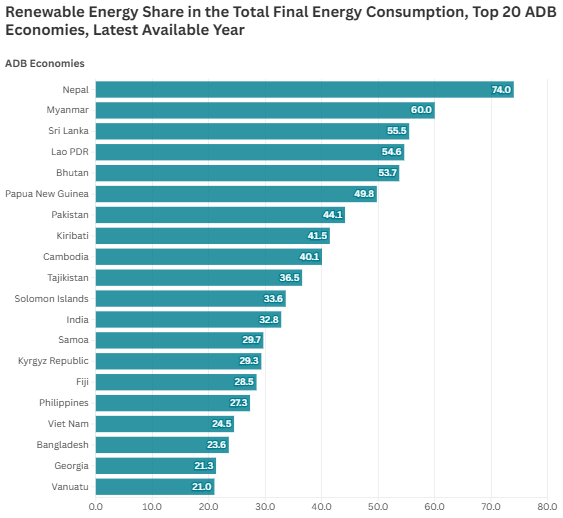
Renewables now account for more than half of energy consumption in seven countries in the region, new data show. Large regional economies, such as Pakistan at 38% and India at 34.1%, are rapidly moving to similar proportions of renewable energy.
But as the region grows wealthier and more urbanized, energy demand is also rising very rapidly. Building thousands more giant solar or wind farms will not overcome this existential paradox; a complete restructuring of regional energy systems is required. Given the intermittent and localized nature of wind and solar, they need to link with a new generation of smart grids that can manage thousands of renewable energy generation nodes. The larger these grids are, ideally encompassing diverse climates and weather systems across many countries, the more successful they will be.
Made with Flourish • Create a chart
With massive investment, the possibilities for regional energy generation are tantalizing–such as an Asian super grid that at any moment can balance optimum generation from connected solar, wind and hydro facilities while meeting varying regional demand. The future’s already here in the form of projects like the Lao PDR–Thailand–Malaysia–Singapore Power Integration Project (LTMS-PIP).
The first phase saw up to 100 megawatts of renewable hydropower imported from Lao People’s Democratic Republic to Singapore via Thailand and Malaysia. The second will see electricity trading as much as double, with additional supply from Malaysia.
Energy financing needs fundamental reform too, so that it’s easier to fund renewables. Multilateral development banks are implementing innovative programs to help countries move to clean energy.
More corporate power purchase agreements and government action would let large industrial groups buy renewable power directly, cutting energy costs and speeding up progress on sustainability and climate resilience.
Renewable energy projects are still seen as risky by many investors, but they are far from impossible to adopt. In Pakistan, for example, government measures have encouraged both industrial and agricultural users to switch to solar power by making low-cost panels available and improving the grid so that solar energy can be fed into it. In the Philippines, some industries are also using innovative renewable energy sources, such as a copper mine that runs on a floating solar power plant—saving land space and using the natural cooling effects of water to improve performance.
Lastly, political and institutional reform is essential, particularly where state-owned enterprises dominate the power sector. The problem is that often the power utility generates, transmits, and distributes. This can lead to a conflict of interest where utilities are reluctant to switch to renewables to protect existing assets.
Separating these under independent system operators would allow diverse energy producers to compete fairly and allow all to see the true cost of different types of power. Team that with comprehensive carbon pricing (or a border adjustment mechanism) throughout Asia and the Pacific, and you create a robust way of making renewables competitive against subsidized fossil fuels.
Source: blogs.adb.org
