


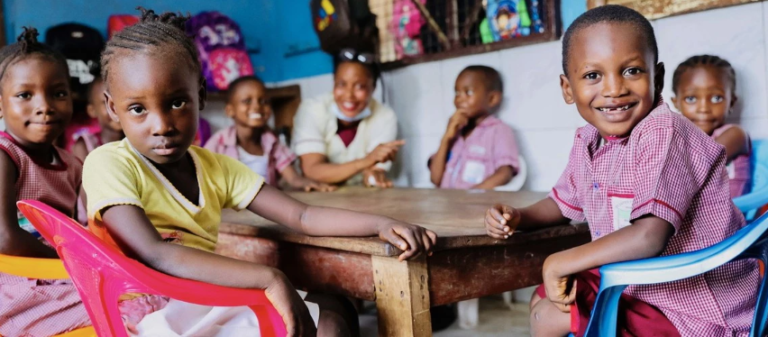
Imagine being asked to build a school on a budget that barely buys a stack of bricks, but no cement, windows or roofing materials. That is what education funding looks like in many low-income countries. With an average annual spending of just $55 per child (PPP$172), spending on education in LICs is in stark contrast even to lower-middle income countries, which allocate $309 (PPP$ 871) per child on average.
Per‑child spending in LICs is still too low to secure learning
Despite these financial constraints, many low-income countries (LICs) make significant financial efforts to support education. Indeed, 87.6% of total education expenditures in LICs come from government sources and households. The Education 2030 Framework for Action recommends that countries dedicate between 4 to 6 percent of GDP and between 15 and 20 percent of public expenditure to education. Nine out of 23 LICs with available data meet the 4% of GDP benchmark, and 12 dedicate at least 15% of total public spending to education.
While these investments expanded primary school enrollment over the past two decades, far too many students are still unable to read and understand a simple text by age 10 . Too many policy discussions in LICs start with “How do we spend less?”—double shifts, larger classes, fewer absent teachers. Yes, these moves can trim budgets. The more urgent question, however, often goes unasked: Can systems afford the essentials that make learning happen—effective teachers, enough materials, and decent infrastructure? In far too many LICs, the answer is still no.
As populations grow and debt levels continue to rise, LICs face an uphill battle to increase spending. Meanwhile, with official development assistance (ODA) for education declining in recent years and further aid cuts enacted or expected from major donors, overall education financing in LICs is declining. Despite these challenges, there is still potential to leverage new sources of financing and improve learning outcomes in these contexts.
Per-child spending is linked to learning outcomes – up to a point
Student learning costs money. Available data shows that governments spending less than PPP $2,220 per primary student are more likely to experience learning poverty above 50% (Figure 1), where learning poverty is the share of students who are unable to read and understand a simple text by age 10. As learning targets increase, so does the associated level of spending per child. Countries investing at least PPP $4,490 per primary student have a better chance of pushing learning poverty below 30% using business-as-usual approaches – this amount is almost 30 times the average amount LICs spend per primary student. All LICs with available data spend less than PPP$337 per primary student. Vietnam is a popular upper-middle income example that achieves high levels of student learning. Vietnam spends $1,391 per student (2022 PPP), while the LIC average per-student spend based on available data is $172 (2022 PPP), according to the Education Finance Watch 2024 database. This means that Vietnam spends 709% more per student that the average LIC.
Figure 1: Association between government spending per primary student and learning poverty
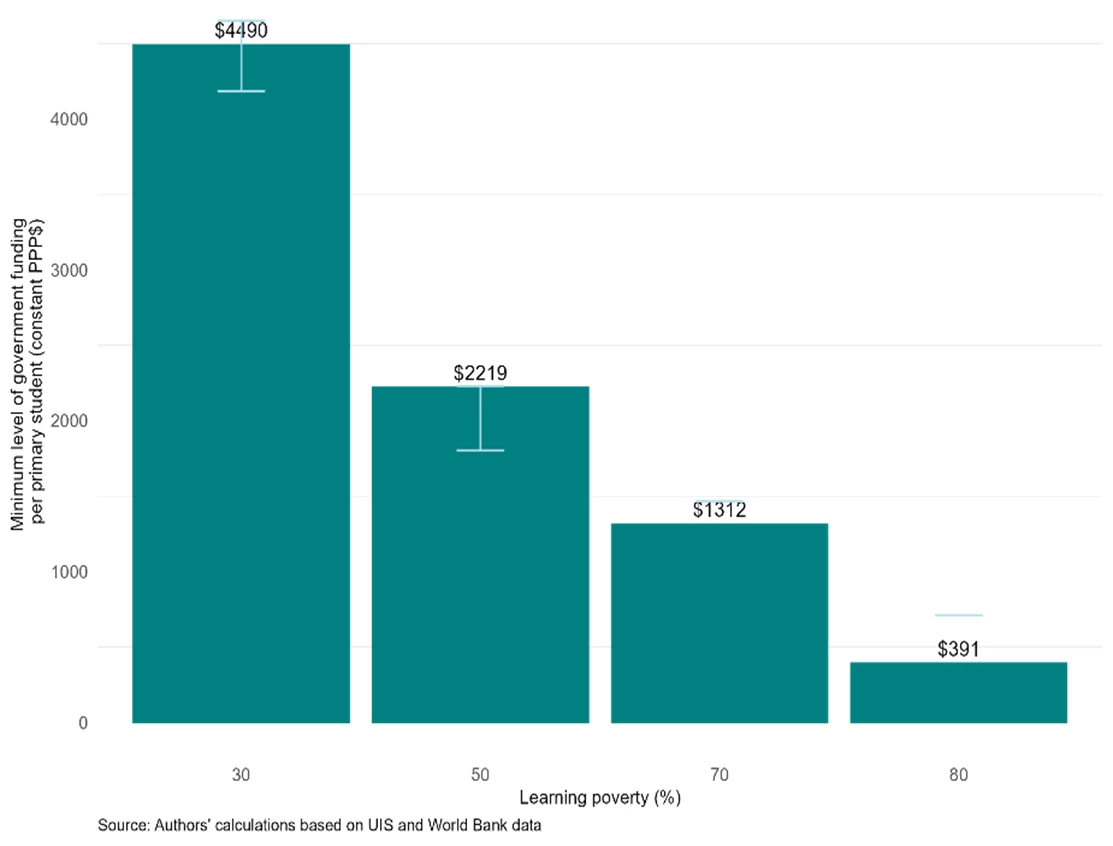
Note: Figure 1 illustrates the empirical relationship between spending per primary student and learning poverty. The figure is based on a logistic regression model, which estimates the probability that a country’s learning poverty exceeds a certain threshold, as a function of spending per primary student, while controlling for GDP per capita. These estimates should not be taken as definitive minimum funding levels necessary for achieving specific educational outcomes. Because they are derived from empirical analysis, they also reflect existing inefficiencies in resource use as well as differences in input prices.
Even the most cost-effective options are costly and challenging to implement for LICs
These severe funding constraints mean that LICs need to make every dollar count. Allocating spending towards higher-efficiency programs can deliver better learning results. In parallel, governments in LICs can and should take measures to improve system governance and the efficiency of current spending.
There are proven ways to improve learning outcomes efficiently. Two of the most cost-effective “Best Buys” include targeting instruction based on students’ learning level rather than grade ( i.e. “Teaching at the Right Level”), and enhancing pedagogy through structured lesson plans with linked student materials, teacher training, and monitoring.
However, even these highly effective interventions can be costly for LICs. Low-cost examples include the Tusome structured pedagogy program for early grades in Kenya which cost about $8 per student per year, and Madagascar, where in-person “Teaching at the Right Level” (TaRL) programs cost about $10 per student. In contrast, a pilot TaRL adaptation serving over 1,500 students in Guinea cost about $87 per student.
Table 1 below provides unadjusted cost figures for several of these interventions. While not directly comparable, the figures give a sense of the range of implementation costs for these interventions. Recent estimates from the What Works Hub for Education of the yearly marginal additional cost of improving foundational literacy on top of existing budgets is at about $5 per student, if everything is implemented optimally – design, training, procurement, etc. The estimate provides helpful decompositions of expected costs, though real-world implementation may cost much more. In LICs, with average per‑child spending of $55, this investment would still be nearly a 10% budget increase which is often hard to secure.
Table 1: Per-student costs of TaRL and Structured Lesson Plans
| Intervention | Country | Sample | Initial Implementation Year | Dollar cost per student per year |
|---|---|---|---|---|
| Structured lesson plans (3 subjects) | Kenya | 847 schools (pilot) | 2013 | $8.17 |
| Structured lesson plans (2 subjects) | The Gambia | 2,060 students | 2018 | $241.59 |
| Structured lesson plans (1 subject) | Papua New Guinea | 39 schools | 2018 | $57 |
| Structured lesson plans (2 subjects) | Kenya | 22,000+ public schools, 5,000 private schools, 1,500 alternative schools | 2021 | $4 |
| TaRL (2 subjects) (Balsakhi program) | India | 122 schools | 2007 | $4.5 |
| TaRL (2 subjects) (computer-assisted learning) | India | 55 schools | 2007 | $15 |
| TaRL (2 subjects) | Madagascar | 70 schools | 2019 | $11 |
| TaRL (2 subjects) | Guinea | 10 schools | 2022-2023 | $87 |
Note: We note that cross-study comparability of figures is challenging as studies differ in how costs are defined and what is included among other variables. There is no specific data available for Niger and Sierra Leone. We invite members of those programs to contact us to complete and expand this table.
These “best buys” approaches may lift learning more reliably in places like India or Kenya since they and other middle-income countries invest more per student, can more readily implement at scale, and have better‑equipped teachers than LICs. In LICs, the same interventions are frequently donor‑funded and NGO‑run—often effective in the short term, but difficult to sustain once external support recedes. This highlights the broader challenge: While efficiency improvements are critical, we lack evidence that strong learning outcomes can be achieved nationwide at the current average funding level in LICs.
A vision forward to finance learning in LICs
Increasing student learning and education spending in LICs is difficult, but not impossible. The most promising approach is by strengthening domestic public finance, particularly through increasing government revenues.
Government and household contributions currently make up nearly 88% of education spending in LICs and 98% in lower-middle income countries. Yet, most LICs maintain tax collection rates below 10% of GDP—well under the IMF’s recommended 15%—which often results in low-quality public services. In a context of the large and growing young population in Africa, investing in education to lay the foundation for a skilled workforce is particularly important. Although reforms in taxation and private contributions may face political resistance, policymakers can clearly communicate that achieving quality services requires everyone to contribute their fair share.
Public, private and external funding could be mobilized to invest in the most effective learning approaches by:
- Unlocking more domestic financing: Governments can maintain and even increase education financing by:
- Expanding direct taxation—such as local taxes, property taxes, and skills levies—can help increase revenues for education.
- Increasing government effort, as reflected by a higher share of public expenditure allocated to education in some cases.
- Pursuing prudent debt policies to safeguard fiscal space for education investments.
- Taping into private funding sources, in particular by:
- Encouraging the use of student loans and household contributions to finance post-secondary education, leveraging the strong private returns to justify a greater share of private funding.
- Leveraging remittances through instruments such as matching, remittances bonds or diaspora bonds to enhance household investments in children’s education. For example, evidence from El Salvador demonstrates that incentives, such as matching schemes, can significantly motivate individuals to allocate more remittances towards supporting children’s education.
- Optimizing the impact of external financing through:
- Better targeting ODA and philanthropy to LICs and to programs that have proven effective in improving learning.
- Leveraging ODA to support improved domestic resource mobilization and reduce countries’ debt burden, such as the “Debt for Development” swap in Cote d’Ivoire.
Others have explored creative ways to leverage more financing for education. Haiti earmarks taxes on telecom services and international remittances for education; Jamaica raises an education tax through payroll contributions from workers and employers; and several countries use employer‑paid skills and training levies—collected via payroll—to fund workforce training programs like Colombia’s National Training Service and Brazil’s National Service for Industrial Training. Other innovations can also be explored, such as domestic wealth taxes targeting individuals with very high levels of wealth and the G20 proposal to tax the wealthiest individuals for development aid, including education.
Source: blogs.worldbank.org
