


Ships move most internationally traded goods between countries. Low-cost seaborne transport allows countries to import essential commodities – such as food, clothing, and pharmaceuticals – and export their own signature products competitively. To safeguard low transport costs, we have analyzed how more energy efficient shipping can support ships in switching to new energy sources in a cost-efficient way.
In the recent past, public discourse around the maritime transport sector’s energy transition has mainly focused on alternative fuels. A quick search through the industry’s sectoral media outlets shows that most coverage dealt with green fuels like biofuels, hydrogen-based fuels, or liquefied natural gas – touted as alternatives to oil-based fuel like heavy graded fuel oils or distillates. Energy efficiency, however, only appeared in less than a third of energy transition reporting.
Is the world overlooking the significant potential for lower emissions and lower costs in a sector that moves 70-80 percent of global trade every day?
Putting Ship Energy Efficiency Back in Focus
In our recent Keys to Energy-Efficient Shipping report, we set out to answer this question by modelling how greater energy efficiency could shape maritime transport over the coming years.
The results were striking: in 2030, up to about 40 percent of ship emissions can be cut by energy efficiency alone. This means that just maxing out energy efficiency will be more than enough to reach the targets of the International Maritime Organization of reducing emissions by 20-30 percent until 2030. This is good news not only for those concerned about climate change, but also for vulnerable communities living close to ports, who are exposed to harmful air pollution from ship traffic.
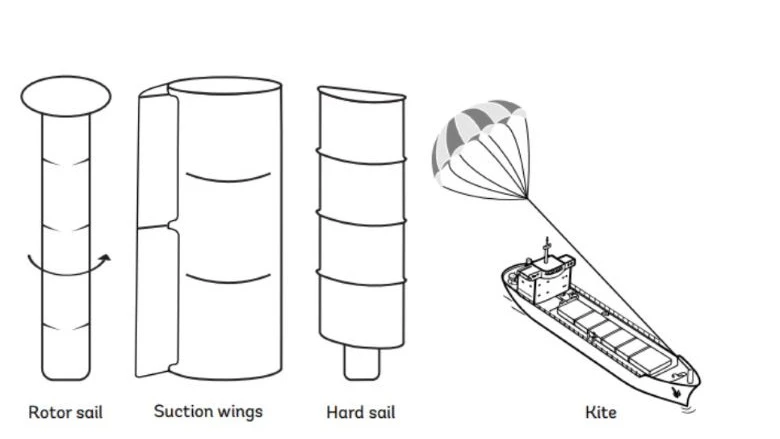
Importantly, more than half of these energy-efficiency measures come at a negative cost, meaning they pay for themselves. Cost savings from reducing energy consumption fully cover – and often exceed – the costs of installing wind-assisted propulsion (like rotor sails on bulk carriers) or reducing the speed of container ships.
All of this makes energy efficiency the ideal complement to alternative fuels. Together, these efforts can drive shipping’s energy transition, presenting a significant market opportunity for developing countries like South Africa, Colombia, and Morocco. Our estimates show that as much as $220 billion can be saved every year in the transition from fossil fuels to green fuels. As such, energy efficiency measures not only minimize the fuel bill of new or retrofit ships running on green methanol or green ammonia, but also benefit incumbent vessels still dependent on fuel oil through lower fuel consumption.
Wind-assisted propulsion systems can make ships more fuel-efficient
Why is Energy Efficiency Still a Hard Sell?
The economics are positive; the environmental benefits are significant. So, despite the obvious cost-effectiveness and emissions reduction potential, why are we still far from maxing out energy efficiency in shipping?
The answer is simple, but the solutions are complex. In shipping, several barriers hinder wide-scale adoption of energy efficiency measures. These barriers can be economic, behavioral, or organizational. From an economic perspective, ship owners would need to invest in measures like fuel-efficient propeller designs. Fuel is often paid for by the charterer of the vessel – the commercial party which leases the ship for a longer period. The lease payment – or hire – unfortunately does not include a high enough premium to recover the costs of the energy efficiency investment, therefore providing little incentive to invest in energy efficiency.
“All Hands on Deck” For More Energy-Efficient Shipping
Overcoming these barriers will be key to unlocking the full economic and environmental potential of energy-efficient shipping. Solving the barrier puzzle will require “all hands on deck” – from policymakers to industry actors; from ports to financiers.
Policymakers can play a key role in advancing performance standards for better operational and technical energy efficiency. Industry can continue and further enhance promising demonstration projects, showing that energy-efficient shipping is real and yields tangible benefits. Ports play an important role in adopting digital solutions to optimize port calls, enabling ships to arrive just-in-time when a pier to load or discharge effectively becomes available. And finally, financiers should also explore innovative instruments that allow for a fair distribution of fuel savings benefits, especially when these benefits do not fully accrue to the asset owner.
Unlocking the benefits of fuel-efficient shipping represents a significant opportunity for both short-term and long-term economic and social gains. Stakeholders across the maritime sector have the unique opportunity to simultaneously boost efficiency, save on costs, and improve the health of millions. The time to act is now.
Source: blogs.worldbank.org
